 |
Venus and Adonis
Luca Cambiaso - circa 1569
|
Contributed by Patrick Webb
of Real Finishes
"Were beauty under twenty locks kept fast, yet love breaks through and picks them all at last" - Venus and Adonis; William Shakespeare
I learned a good bit of Spanish and French growing up and went on to study Italian and Portuguese as an adult. There are many things to appreciate about the Latin languages but one I've always been particularly fascinated with is the extensive use of the subjunctive as a tense, mood or more amply described as a means of expression. It survives in diminished part in contemporary English; however, I would contend that the best examples be found in the Middle English of the Canterbury Tales or the Early Modern English of Shakespeare, the King James Bible and similar works.
The subjunctive frame of view exists outside of time, quite literally the subjunctive aims at
underlying meaning. As such it lends itself to verbal expression of opinion, suggestion, desire and the transcendental. For good reason then it survives in English poetry where the conventions of language themselves are transcended, the use of words to push beyond the limitation of the "indicative" that is the proclamation of mere objective facts. As such it can be incredibly useful to express psychological states, conditions and behaviours such as pain, ecstasy and the oft subject of subjunctive expression: beauty.
English, Science and Beauty
English has evolved over the past 300 years into the unquestioned language of science. There are numerous factors attributed to this shift, much of them surrounding political and technological developments. Of interest, there is a correlation between the ascendancy of English as the
lingua franca of science and the diminishment of the subjunctive in writing and particularly speech. Of course, this correlation does not necessarily entail causation. Nevertheless, my sense is that they may very well be related phenomena. Every aspect of the modern world has become more scientific, more rational and empirically rigourous which drastically has transformed the way we think and express ourselves. This is especially evident in the English speaking world. We tend towards the
indicative, we live our lives, organise our societies according to
objective facts. For the 21st century, that well describes the methodology of a now worldwide scientific community.
Science is largely an empirical endeavour, at least in its daily routine. That is to say the practise of science is about measuring the world. What matters? There is a bias in empirical study quite literally towards matter, the material. Matter itself (along with radiation and force) is quantifiably measurable. Science essentially makes the claim that what it can measure is the best representation of reality. Although the claim is symbolic, often it is conflated with reality itself, science as soothsayer. Interestingly, the etymological root of the ostensibly distinct English words "magic, matter and measure" is Indo-European, specifically the Sanskrit "
Māyā" (माया) which binds all of these meanings together such that the supposed subject and object of measurement is intrinsically wrapped up with the concept of illusion.
This pursuit of a scientific classification of beauty has been attempted for the past couple of centuries and continues today where an initial question inevitably arises, "Is beauty real"? The scientific method automatically attempts to determine reality-potential by asking, "Is beauty measurable?" It's been a frustration too as will always be the case when applying scientific methods to anything immaterial. The first challenge science faces is one of categorisation and objectification, "What is beauty?" The next, "Does this defined object we're calling beauty exist and what do we mean by exist?" Scientific study of beauty has been abandoned repeatedly under the justification that if it can't be defined and measured beauty can not be "real" and therefore not an appropriate subject of scientific inquiry. Other scientists have sought a work around by proposing various limiting definitions of beauty, extractions which are perhaps verifiable through statistical analysis though none have seemed to capture what beauty is exactly. Within the field of psychology it has been proposed that beauty might be relative, each individual has or develops his own conceptual framework; whereas some sociologists have posited that beauty may be a mass phenomenon, something that can be witnessed in differentiation of tastes across cultures and through time. I find it fascinating that when I'm reading Shakespeare or contemplating a Renaissance painting e.g. I experience beauty completely but when I try to express the experience verbally, attempt to quantify it or subject it to logical analysis my results are desiccated; I'm incapable of expressing my experience in scientific terms or even get very far linguistically. Yet, I continue to act in the world
"as if" beauty were very much real.
Beauty and Pain
Is pain real? From a scientific perspective that's a difficult question. It has many of the same challenges to scientific analysis previously raised in regard to beauty. But we sure as hell act as if it is real. In fact, it may be the defining trait of human existence, certainly a primary motivating force. No, I don't think we're ready to deny pain just because we can't clearly define or objectify it. Pain as a word can encompass entire ranges of experience. There are certainly psychological pains (loss, sadness, etc.), conceptions of abstracted thought. Likewise we can perceive pain through our senses: visual, auditory but noteworthy amongst them being tactile pains, those associated with our sense of touch.
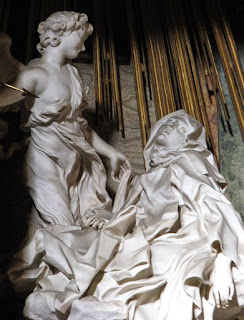 |
The Ecstasy of Saint Teresa
Gian Lorenzo Bernini - circa 1652
|
Even restricted to touch, pain as an experience defies easy classification. There is the pain of pressure from a squeeze or impact. The pain of burning from searing heat. The sharp pain of a razor's incision. And even the incredible sensitivity immediately following the climax of orgasm. We're unclear if the latter is pleasure or pain; yet we moan, pull away and even scream as if we were in agony. Although we might tend to think of pleasure as the opposite of pain, I think this may be not quite right. Pain's opposite might not be pleasure but beauty and strictly speaking not its opposite, rather pain's counterpart. Together they are the ontological fundamentals, foundational aspects of what it is to be human. Not referential to anything else they are like the bedrock of the soul, manifestations of a subjunctive will that lies beneath conscious thought. Although they can be temporarily masked from consciousness with great effort by abstraction and self delusion both pain and beauty remain ever present.
Why dull the pain or deny the beauty when you can feel potent and alive as you imbibe it all in? The traditional arts of painting, sculpture, music, craft, theatre etcetera are proven, effective means for revealing beauty and pain as the human expression of the subjunctive, underlying, ineffable experience of the foundational realities that transcend conscious thought.
Contributed by Patrick Webb

 This brief post considers the statue Medusa With the Head of Perseus by Luciano Garbati. The statue inverts the death of the gorgon Medusa by the hands of Perseus. It is in fact not a new piece, an original having been made in 2008. Since its initial public release in 2018 there has been a great deal of criticism leveled against the artist that
the statue is methodologically illiterate and logically challenged. And from feminist quarters the usual charges regarding any female nude statue as being an object of sexual exploitation, male aggression, etc. I
find such criticisms not baseless per say but uninteresting. Whether or
not an artist chooses to express his work under the constraints of tradition, clothed or nude is in my
opinion his prerogative. As a private commission or on display in a
show or gallery (as this statue has been in the past) I really would
have nothing to say. What is of interest here is the decision by NYC Art in the Parks to commission a bronze version to face the New York County Criminal Court thus making it a civic work of sculpture.
This brief post considers the statue Medusa With the Head of Perseus by Luciano Garbati. The statue inverts the death of the gorgon Medusa by the hands of Perseus. It is in fact not a new piece, an original having been made in 2008. Since its initial public release in 2018 there has been a great deal of criticism leveled against the artist that
the statue is methodologically illiterate and logically challenged. And from feminist quarters the usual charges regarding any female nude statue as being an object of sexual exploitation, male aggression, etc. I
find such criticisms not baseless per say but uninteresting. Whether or
not an artist chooses to express his work under the constraints of tradition, clothed or nude is in my
opinion his prerogative. As a private commission or on display in a
show or gallery (as this statue has been in the past) I really would
have nothing to say. What is of interest here is the decision by NYC Art in the Parks to commission a bronze version to face the New York County Criminal Court thus making it a civic work of sculpture.


